
Research comparison · Receptor biology
GLP-3RT vs GLP-2TZ: Dual and triple agonism compared
Compare receptor targets, molecular design, signalling evidence and documentation for these two distinct research peptides.
Direct Answer
The main difference between GLP-3RT and GLP-2TZ is receptor targeting. GLP-2TZ is a dual GIP and GLP-1 receptor agonist. GLP-3RT is a triple agonist targeting GIP, GLP-1 and glucagon receptors. The additional glucagon receptor target distinguishes the triple-agonist profile; it does not, by itself, establish greater potency or a larger response in every research model.[1][2]
GLP-3RT and GLP-2TZ are Luxara catalogue names associated with LY3437943 and LY3298176, respectively. Independent publications use the underlying scientific identities. Literature findings describe the investigators’ materials, rather than independently verifying a Luxara sample.
Key Takeaways
- Dual versus triple: both profiles include GIPR and GLP-1R; GLP-3RT also includes glucagon receptor, abbreviated GCGR, agonism.[1][2]
- Different molecules: both published structures have 39 amino acids, but their sequences and lipid-attachment positions differ. This is not a comparison of an otherwise identical molecule with one extra receptor target.[1][3]
- The endpoint matters: receptor binding, cyclic AMP signalling, β-arrestin recruitment and internalisation describe different aspects of activity.[2][8]
- Comparative evidence exists: a 2025 paper includes both molecules in receptor-signalling comparisons, and a 2026 paper includes comparative cell-line experiments. Endpoints, reference controls and model limitations still matter.[5][11]
- Evaluate the supplied material separately: match the catalogue identity, labelled strength and lot with the available analytical report. Purity alone does not establish content or biological activity.
GLP-3RT and GLP-2TZ at a glance
Both are described in the literature as single, chemically modified peptides with activity at multiple receptors. The comparison below uses the same molecular and pharmacological criteria for each identity.[1][3]
On small screens, scroll each table sideways to view all columns.
| Comparison criterion | GLP-3RT | GLP-2TZ |
|---|---|---|
| Research identifier | LY3437943 | LY3298176 |
| Principal receptor profile | Triple GIPR, GLP-1R and GCGR agonism | Dual GIPR and GLP-1R agonism |
| Peptide backbone | 39 amino acids; one modified peptide | 39 amino acids; one modified peptide |
| Lipid modification | C20 fatty diacid connected through a linker at lysine 17 | C20 fatty diacid connected through a linker at lysine 20 |
| Published receptor structures | Complexes with GLP-1R, GIPR and GCGR | Complexes with GLP-1R and GIPR |
| Distinctive mechanistic question | How a single ligand engages three related receptor systems | How dual agonism and pathway-dependent signalling relate to molecular recognition |
| Detailed Luxara resource | GLP-3RT Canada research guide | GLP-2TZ Canada research guide |
Molecular and receptor-profile sources: foundational pharmacology and structural studies.[1][2][3][4] “Dual” and “triple” describe the principal agonist profiles; they do not mean equal activity at every target or exhaustive testing against every receptor.
In plain English: receptor coverage tells you which signalling systems are involved. It does not tell you how strongly each system responds under every set of experimental conditions.
What changes with the glucagon receptor target?
GIPR, GLP-1R and GCGR belong to the class B1 family of G protein-coupled receptors. Their names refer to the glucose-dependent insulinotropic polypeptide, glucagon-like peptide-1 and glucagon receptors. Published work examines how peptide recognition connects with G protein engagement and downstream cyclic AMP, or cAMP, signalling.[3][4]
GLP-3RT: three receptor targets
The LY3437943 pharmacology paper characterised activity across all three receptors. The GCGR component adds a separate receptor pathway to the comparison, while receptor-specific potency remains a measured property rather than an equal three-way allocation.[1]
GLP-2TZ: two receptor targets
The LY3298176 pharmacology paper characterised dual agonism and a relative preference for cAMP signalling over β-arrestin recruitment at GLP-1R. That finding concerns pathway behaviour in the reported assays, rather than an additional receptor target.[2]
A shared second messenger does not identify the receptor
Because these receptor systems can converge on cAMP, a cAMP signal alone does not establish which receptor produced it in a mixed-receptor model. Receptor expression and the study’s target-specific evidence determine how a result can be attributed. A model without demonstrated GCGR expression cannot establish a GCGR-mediated difference simply because one ligand has a triple-agonist profile.
The molecules differ beyond receptor count
Sequence composition and acylation also differ. Consequently, comparing the two complete molecules does not isolate the contribution of GCGR alone. Structural studies help explain why a peptide’s contacts with related receptors can differ even when both ligands share some targets.[3][4]
For wider context, explore the GLP-1, GIP and triple-agonist research family and our peptide pathway research overview.
Why “stronger” needs a defined endpoint
A meaningful comparison identifies the receptor, experimental system, reference ligand and measured response. Binding affinity, functional potency and maximal response are different quantities. A ligand can show a strong maximal cAMP response while exhibiting a different pattern of G protein recruitment or receptor trafficking.[8]
| Measurement | Question it answers | Comparison limit |
|---|---|---|
| Binding affinity | How the ligand interacts with the receptor in a defined binding assay | Binding alone does not establish the size or duration of a downstream response. |
| Functional potency, often EC50 | The concentration producing half of the fitted response range above baseline | Values depend on the endpoint, receptor expression and signal amplification. |
| Maximal response, Emax | The largest fitted response in that assay | A similar maximum does not imply the same potency or trafficking behaviour. |
| β-arrestin recruitment | Recruitment of a signalling and regulatory protein to the receptor | This endpoint should be distinguished from cAMP production. |
| Receptor internalisation | Movement of receptors from the cell surface into intracellular compartments | It describes trafficking rather than directly measuring binding affinity. |
These distinctions are supported by the pharmacology and trafficking studies cited here.[2][8]
Albumin can change the comparison. Willard and colleagues reported shifts in LY3298176’s apparent potency when albumin was present. Protein binding changes the freely available ligand fraction, so albumin-containing and albumin-free assays are not equivalent comparison conditions.[2]
Normalisation also needs attention. A value expressed relative to native GIP is not automatically comparable with one expressed relative to native GLP-1 or glucagon. Those percentages have different reference points. Read the original legend before treating a receptor-balance chart as an absolute potency ranking.[5]
What the current evidence adds
The strongest comparison combines measured pharmacology, deposited structures and a clear account of what later work actually tested. These evidence types complement one another; they do not form a single interchangeable ranking.
Evidence reviewed through . Read Luxara’s editorial and sourcing standards for our approach to references and evidence interpretation.
Measured pharmacology
Foundational receptor profiles
Willard and colleagues characterised LY3298176’s dual-receptor pharmacology and GLP-1R signalling bias. Coskun and colleagues characterised LY3437943’s triple-receptor profile. These separate studies establish the central receptor distinction; comparisons of their numerical results still require attention to assay conditions.[1][2]
Structural evidence
Receptor-bound molecular structures
Sun and colleagues resolved LY3298176-bound GIPR and GLP-1R complexes. Li and colleagues resolved LY3437943-bound GLP-1R, GIPR and GCGR complexes. These records enable inspection of ligand recognition and receptor contacts, alongside each study’s functional evidence.[3][4]
Comparative figures
Both molecules appear in signalling comparisons
Dinsmore and colleagues included both identities in figures comparing GLP-1R cAMP potency and β-arrestin-2 recruitment, and in a receptor-balance analysis. The figure legends identify normalisation to reference ligands and data from the main and supplementary tables. This is relevant comparative literature, but inclusion in one figure alone does not establish that every underlying measurement came from identical experiments.[5]
Computational evidence
New modelling informs molecular questions
Vishnoi and colleagues modelled multi-receptor peptide interactions, including reference backbones associated with these identities. The reference peptides were modelled without their lipid conjugates. Calculated interaction enthalpies are model-dependent predictions, not measured binding affinities or a functional potency ranking of the complete acylated materials.[6]
Cell-model comparison
Comparative observations in HK-2 cultures
Ding and colleagues compared LY3298176 and LY3437943 alongside semaglutide in HK-2 tubular epithelial cell-line experiments. In senescence-model cultures, all three were associated with a lower proportion of G2/M-arrested cells and lower collagen III and α-SMA protein expression. The cell-cycle readout concerns progression towards cell division; the protein markers describe cellular responses within that model.[11]
The experiments did not establish equivalent receptor activation across compounds. These cellular findings therefore do not isolate GCGR’s contribution or establish a universal potency ranking.
Update focus: this revision adds the 2025 comparative signalling work, distinct 2026 computational and cell-model findings, and direct access to structural records. The receptor-target distinction remains the clearest answer; later evidence adds detail rather than making receptor count a universal performance score.
Inspect the structural evidence directly
RCSB Protein Data Bank records provide the deposited molecular models and associated experimental and validation information. The following records correspond to the two structural studies discussed above.[7]
| Receptor complex | GLP-3RT identity: LY3437943 | GLP-2TZ identity: LY3298176 |
|---|---|---|
| GLP-1R | PDB 8YW3 · 2.68 Å | PDB 7RGP · 2.90 Å |
| GIPR | PDB 8YW4 · 3.26 Å | PDB 7RBT · 3.08 Å |
| GCGR | PDB 8YW5 · 2.84 Å | Outside the principal dual-agonist profile; no corresponding record listed here |
Resolution describes the structural reconstruction. It is not a measure of peptide purity, receptor potency or the quality of a supplier’s material. The complexes were resolved in separate studies and should be interpreted with their individual constructs and validation records.[3][4][7]
Evaluate the research material and its documentation
A published molecular identity and an analytical report answer different questions. The literature characterises the investigators’ material. The report describes the submitted sample and the analyses performed. Connecting a catalogue entry to a lot therefore requires documentation beyond a shared name.
Luxara product pages state a 99%+ purity standard. Our public laboratory-results directory provides product- and lot-associated entries with linked original reports. The applicable report establishes what was actually measured. Our transparency page explains the relationship between those entries, declared strength, reported purity and measured content where available. Confirm the available lot with Luxara when its relationship to a posted report is unclear.
| Documentation item | What to inspect | What it does not establish alone |
|---|---|---|
| Identity evidence | Stated compound, sample identification and the scope of reported mass-spectrometric or other identity analysis | A matching nominal mass alone does not establish every sequence, stereochemical or impurity detail. |
| Chromatographic purity | Method, chromatogram and how the reported percentage was calculated | Peak-area percentage is not automatically a mass fraction or a measurement of milligram content. |
| Measured content | Whether the amount of the target compound was separately quantified and reported | High purity does not independently establish the labelled quantity. |
| Lot traceability | Relationship between the product label, lot reference, report date and submitted sample | A report does not mean every vial was individually tested. |
| Additional testing | Specific results for any required sterility, endotoxin or stability assessment | Purity and identity findings do not imply these separate analyses were performed. |
Analytical interpretation should reflect the method’s intended purpose, specificity and reported acceptance criteria. ICH Q2(R2) and Q6A provide general analytical principles; citing them does not imply Luxara certification under those standards.[9][10]
For practical context, read how to read a peptide COA, the Luxara Quality Standard and our peptide purity guide. For material-integrity questions, consult the storage and stability overview and the applicable documentation.
Keep testing and biological evidence separate. Analytical results support the measurements reported for the tested sample. They do not establish receptor activity for every supplied vial or guarantee reproducible experimental outcomes.
Research sourcing in Canada
For Canadian laboratories evaluating either catalogue entry, documentation, traceability and a reachable supplier are useful starting points. Luxara’s where to buy peptides in Canada guide expands on supplier-evaluation criteria and the documentation to examine before sourcing research materials.
Luxara’s product pages identify Ontario-based fulfilment. Review the current Canada shipping information for order-specific delivery context. USA-based researchers can consult the USA shipping guide. For the available lot or a report-matching question, contact Luxara with the compound and labelled strength.
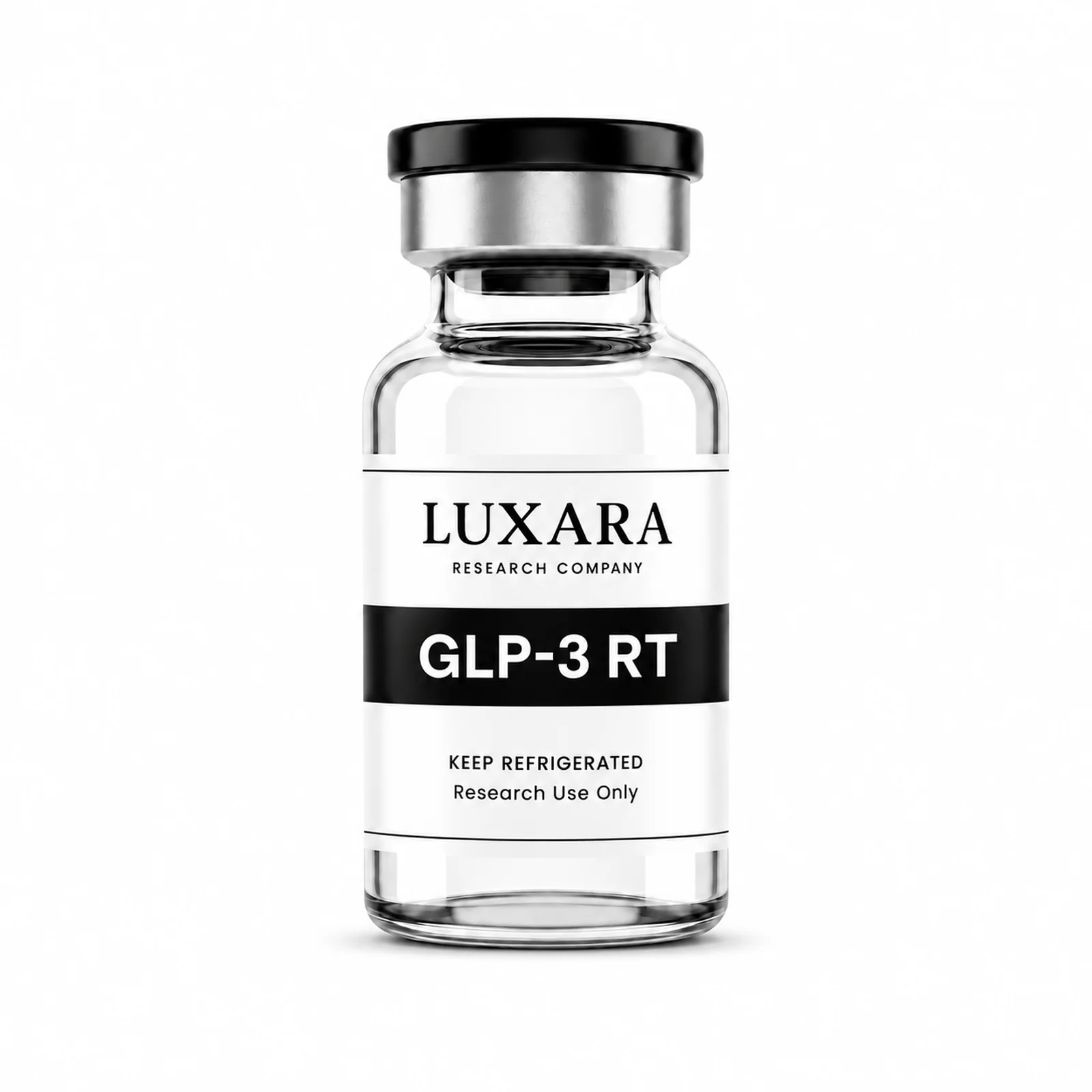
Inspect the current catalogue entry and specifications.
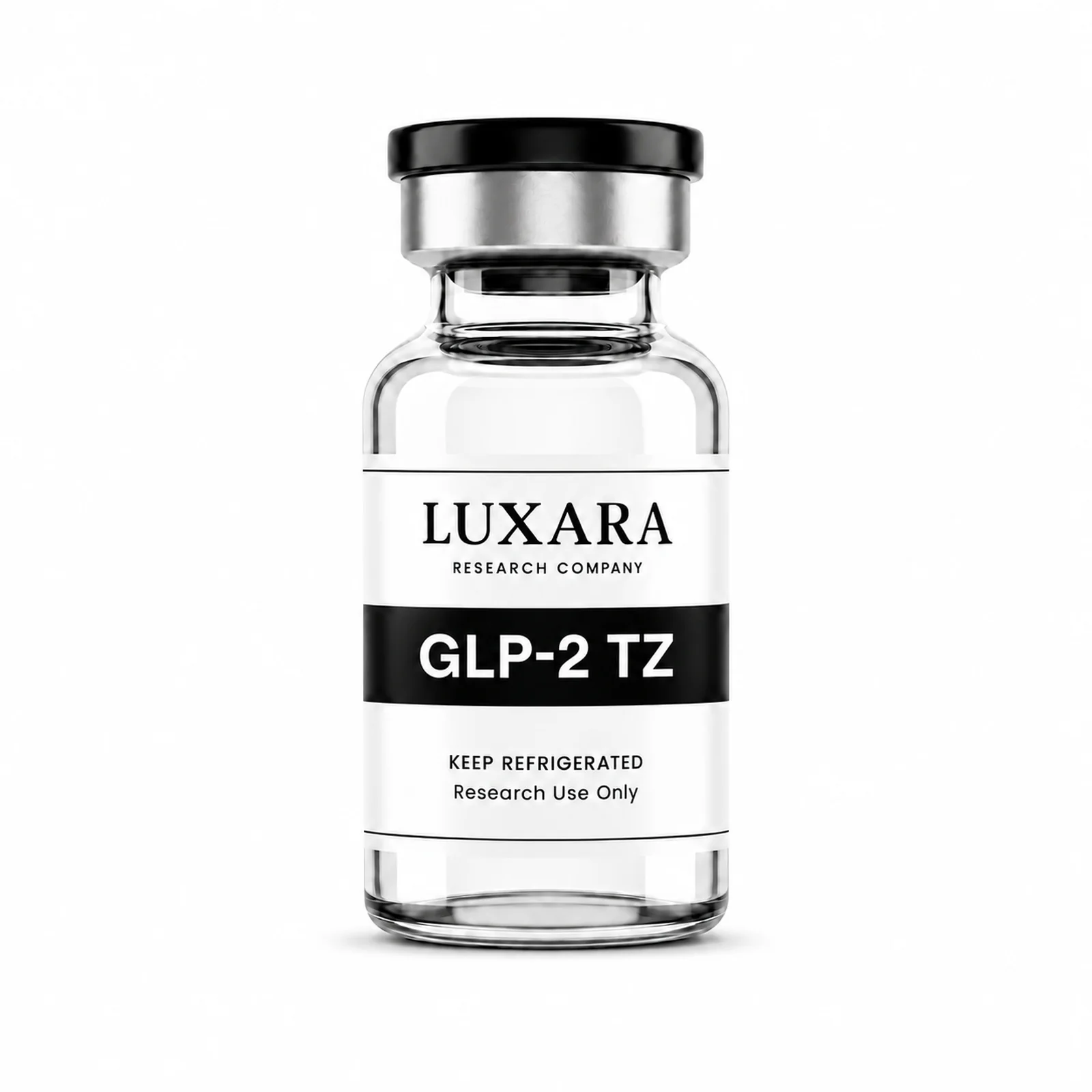
Inspect the current catalogue entry and specifications.
Browse the laboratory research catalogue alongside the available product and analytical documentation.
Continue your research
Use the individual guides for deeper compound coverage and the documentation resources for supplier and sample evaluation.
- GLP-3RT research guide Triple-receptor biology, molecular identity and supporting literature.
- GLP-2TZ research guide Dual-receptor pharmacology, signalling bias and cell-model evidence.
- Canada peptide Knowledge Hub Broader scientific and analytical topics in the Luxara research library.
- Luxara Research Index Find related compound guides, mechanisms and comparisons.
Frequently asked questions
What is the main difference between GLP-3RT and GLP-2TZ?
Is GLP-3RT simply GLP-2TZ with an extra receptor target?
Does triple agonism mean equal activity at three receptors?
Is either compound universally more potent?
Has published research compared both molecules?
Do GLP-3RT and GLP-2TZ refer to GLP-3 or GLP-2 receptors?
No. These are Luxara catalogue names. They identify the catalogue entries discussed here and should not be interpreted as standard receptor nomenclature. The relevant principal targets are GIPR, GLP-1R and, for GLP-3RT, GCGR.
Does a high-purity COA establish biological activity?
No. Chromatographic purity describes the reported analytical measurement. Identity, measured content and functional receptor activity are separate questions. Review the original report’s scope and its relationship to the labelled material; our COA guide explains the key fields.
What should Canadian researchers review before sourcing either material?
Review the product identity, specifications, available lot and corresponding analytical documentation. Luxara’s Canadian peptide sourcing guide and transparency resources explain these checks. Ask Luxara to clarify any missing or ambiguous lot information.
Sources and primary research
References use author, journal, year and persistent identifiers. Catalogue labels above do not rename the compounds or materials described by the original publications and deposited records.
- Coskun et al. · Cell Metabolism · 2022;34:1234–1247.e9 DOI: 10.1016/j.cmet.2022.07.013. Foundational LY3437943 molecular design and receptor pharmacology.
- Willard et al. · JCI Insight · 2020;5:e140532 DOI: 10.1172/jci.insight.140532. LY3298176 dual agonism, pathway bias and albumin-sensitive assay interpretation.
- Sun et al. · PNAS · 2022;119:e2116506119 DOI: 10.1073/pnas.2116506119. Structural and functional analysis of LY3298176 receptor complexes.
- Li et al. · Cell Discovery · 2024;10:77 DOI: 10.1038/s41421-024-00700-0. LY3437943-bound GLP-1R, GIPR and GCGR structures.
- Dinsmore et al. · Journal of the American Chemical Society · 2025;147:20819–20832 DOI: 10.1021/jacs.5c04095. Multi-receptor peptide research including comparative cAMP and β-arrestin figures.
- Vishnoi et al. · Journal of Computer-Aided Molecular Design · 2026;40:191 DOI: 10.1007/s10822-026-00903-5. Molecular simulations and predicted receptor interaction enthalpies.
- RCSB Protein Data Bank · Original structural records: 8YW3, 8YW4, 8YW5, 7RGP and 7RBT. Deposited receptor complexes, experimental information and validation records associated with references 3 and 4.
- Novikoff et al. · Molecular Metabolism · 2021;49:101181 DOI: 10.1016/j.molmet.2021.101181. Incretin-receptor signalling and trafficking measurements.
- ICH Q2(R2) · Validation of Analytical Procedures · FDA guidance record, 2024 Analytical validation principles, including specificity and fitness for an intended analytical purpose.
- ICH Q6A · Specifications · FDA guidance record, 2000 General distinctions among identification, assay, purity and other specification tests.
- Ding et al. · iScience · 2026;29:117174 DOI: 10.1016/j.isci.2026.117174. The cellular findings discussed here refer specifically to the paper’s HK-2 experiments.