
Research guide · Canada
GLP-3RT Canada Research Guide
GLP-3RT is Luxara’s catalogue name for material identified as LY3437943, a peptide characterised by activity at the GLP-1, GIP and glucagon receptors. Explore its receptor biology, structural evidence and laboratory documentation.[1][2]
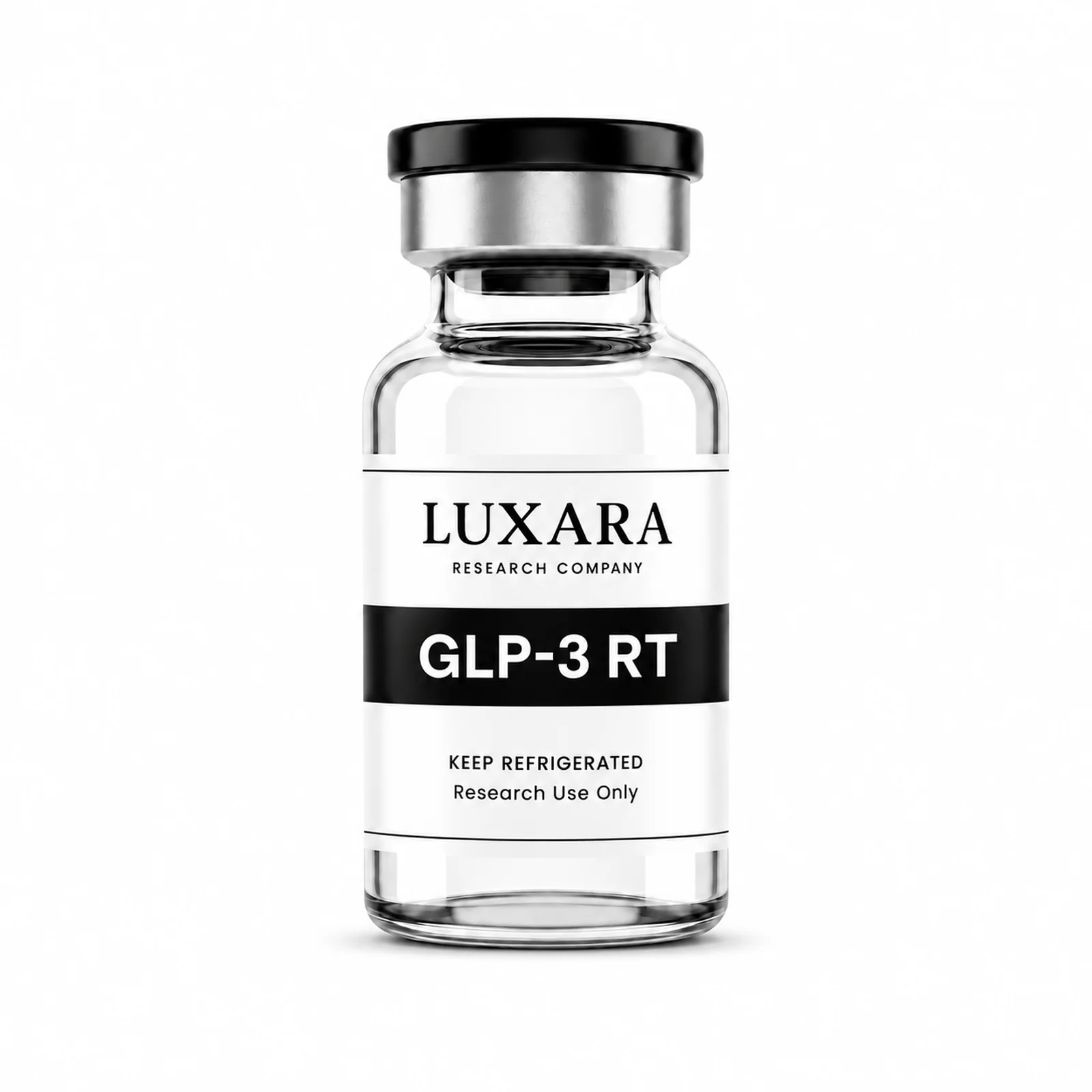
What is GLP-3RT?
The underlying research identifier is LY3437943. The catalogue label GLP-3RT connects Luxara’s product to that identity; it is not the name used by the independent publications cited below. Literature findings describe the investigators’ research material and do not independently verify a supplier’s sample.
Triple agonist means one molecule has agonist activity at three receptor targets. It does not mean three peptides are mixed together, or that the activity is equal at every receptor.[1]
Review the GLP-3RT product information alongside the applicable analytical documentation.
Three receptors, distinct research questions
GLP-1R, GIPR and GCGR belong to the class B1 G protein-coupled receptor family. Functional assays and structural studies examine different aspects of peptide recognition and receptor activation.[1][2]
| Target | Receptor name | What the research examines |
|---|---|---|
| GLP-1R | Glucagon-like peptide-1 receptor | Peptide recognition, G protein coupling and cyclic AMP signalling. |
| GIPR | Glucose-dependent insulinotropic polypeptide receptor | Receptor-specific contacts and a distinct functional activity profile. |
| GCGR | Glucagon receptor | The additional receptor interaction that distinguishes the triple-agonist profile from dual incretin agonism. |
Interpretation: binding, cyclic AMP and other signalling readouts answer different questions. A potency value belongs to its assay conditions and should not be treated as a universal ranking.[1][4]
What the evidence adds through 2026
The most useful distinction is between measured receptor activity, experimentally resolved structures and computational predictions.
Functional pharmacology
Coskun and colleagues characterised LY3437943 as a triple agonist. Their in vitro results showed a receptor-dependent activity profile rather than identical potency across all three targets.[1]
Structural evidence
Li and colleagues resolved receptor–peptide–G protein complexes. Conserved contacts and receptor-specific arrangements, including differences around extracellular loop 1, help explain multi-receptor recognition.[2]
Computational comparisons
Vishnoi and colleagues included LY3437943 as a reference in molecular simulations of triple-agonist designs. Calculated interaction energies are predictions, not newly measured binding affinities or evidence about Luxara’s material.[3]
Inspect the original structural records
The Protein Data Bank provides the deposited models and validation information. These records are useful starting points for examining the structural evidence directly.[7]
| Receptor complex | PDB record | Reported resolution |
|---|---|---|
| GLP-1R–Gs | 8YW3 | 2.68 Å |
| GIPR–Gs | 8YW4 | 3.26 Å |
| GCGR–Gs | 8YW5 | 2.84 Å |
A structural model captures an experimental complex, not every conformation or signalling event. Read it together with the functional evidence and the study’s limitations.
GLP-3RT, GLP-2TZ and semaglutide
Receptor coverage is a useful first comparison. It does not establish interchangeable materials, equivalent assay behaviour or a universal “best” compound.[1][4][5]
| Material / reference | Principal receptor profile | Comparison focus |
|---|---|---|
| GLP-3RT LY3437943 | GLP-1R, GIPR and GCGR | Triple-receptor recognition and activation. |
| GLP-2TZ LY3298176 | GIPR and GLP-1R | Dual-receptor pharmacology and signalling characteristics. |
| Semaglutide | GLP-1R | A single-receptor reference in incretin research. |
GLP-3RT and GLP-2TZ are Luxara catalogue labels. Scientific comparisons should use the documented identities and matched experimental conditions.
GLP-3RT vs GLP-2TZGLP-3RT vs semaglutideGLP-2TZ research guide
Evaluate the material behind the name
A scientific publication characterises its own research material. An analytical report characterises the submitted sample using the stated methods. Keep those two evidence streams separate.
| Documentation | What to evaluate | What it cannot establish alone |
|---|---|---|
| Identity | Reported method, reference material and molecular findings. | Complete identity from a purity percentage alone. |
| Chromatographic purity | The method, reported peaks and scope of the percentage. | Net peptide content or every possible impurity. |
| Peptide content | A separate quantitative result and its analytical basis. | Receptor activity or stability over time. |
| Microbiological testing | The specific test and result. Sterility and endotoxin are distinct measurements.[8] | Either result from HPLC/MS testing alone. |
Analytical procedures must be suitable for the measurement being reported. ICH Q2(R2) provides a general framework for evaluating analytical specificity, accuracy and precision.[6]
- Match the record: check the material identifier, sample or lot reference, and report date.
- Read the scope: a result applies to the submitted sample and tests performed; a shared lot label does not mean every vial was tested.
- Check the measurement: purity, content and biological activity are separate attributes.
Luxara makes analytical reports available through its Lab Results and COA page. For interpretation, use How to Read a COA and the Luxara Quality Standard.
Research sourcing in Canada
Luxara fulfils research orders from Ontario, with catalogue prices shown in Canadian dollars. Canadian and USA researchers can review the product information and available documentation before ordering. See the current Canada shipping information or USA shipping guide for destination-specific details.
For a broader supplier checklist, read our Where to Buy Peptides in Canada guide. It explains how to compare analytical documentation, lot traceability and Canadian fulfilment.
Explore the research catalogue
Review GLP-3RT and its documentation
Browse the current catalogue, then compare the listed material with the relevant analytical record.
Frequently asked questions
What does the name GLP-3RT refer to?
It is Luxara’s catalogue label for material identified as LY3437943. Use the documented research identity when connecting the catalogue entry to scientific literature.
Does triple agonism mean equal activity at three receptors?
No. It describes receptor coverage. Functional activity depends on the receptor, measured endpoint and experimental conditions.[1]
How does GLP-3RT differ from GLP-2TZ?
What new research is included in this guide?
Does a purity result prove biological activity?
No. Chromatographic purity and functional receptor activity are different measurements. A report supports the tests it actually contains.
Where can I review GLP-3RT analytical documentation?
Use the Lab Results page and check the applicable sample or lot reference. The COA guide explains the main report fields.
Browse the complete Luxara Research Index or read our research standards and methodology.
Research use only. This guide covers scientific literature, receptor biology and analytical documentation. Luxara materials are supplied strictly for laboratory research and in vitro studies.
Sources and original research
Source labels below are abbreviated. Original publication records and identifiers are preserved.
- Coskun T, et al. Cell Metabolism. 2022;34:1234–1247.e9. Original LY3437943 receptor pharmacology.DOI: 10.1016/j.cmet.2022.07.013 · PMID: 35985340
- Li W, et al. Cell Discovery. 2024;10:77. Receptor-complex structures and functional interpretation.DOI: 10.1038/s41421-024-00700-0 · PMCID: PMC11255275
- Vishnoi S, Hudson S, Bhattacharya S, Thompson D. Journal of Computer-Aided Molecular Design. 2026;40:191. Computational triple-agonist design and reference comparisons.DOI: 10.1007/s10822-026-00903-5 · Published July 30, 2026
- Willard FS, et al. JCI Insight. 2020;5(17):e140532. Original dual-receptor and signalling research for LY3298176.DOI: 10.1172/jci.insight.140532
- Lau J, et al. Journal of Medicinal Chemistry. 2015;58(18):7370–7380. Original semaglutide molecular-design research.DOI: 10.1021/acs.jmedchem.5b00726 · PMID: 26308095
- ICH Q2(R2): Validation of Analytical Procedures. March 2024. General analytical-validation principles, published by the FDA.
- RCSB Protein Data Bank: 8YW3 (GLP-1R), 8YW4 (GIPR) and 8YW5 (GCGR). Original structural-data records associated with Li and colleagues’ study.
- ICH Q6A: Specifications. December 2000. Technical reference distinguishing analytical and microbiological testing categories.