
Research guide · Canada
GLP-2TZ Canada Research Guide
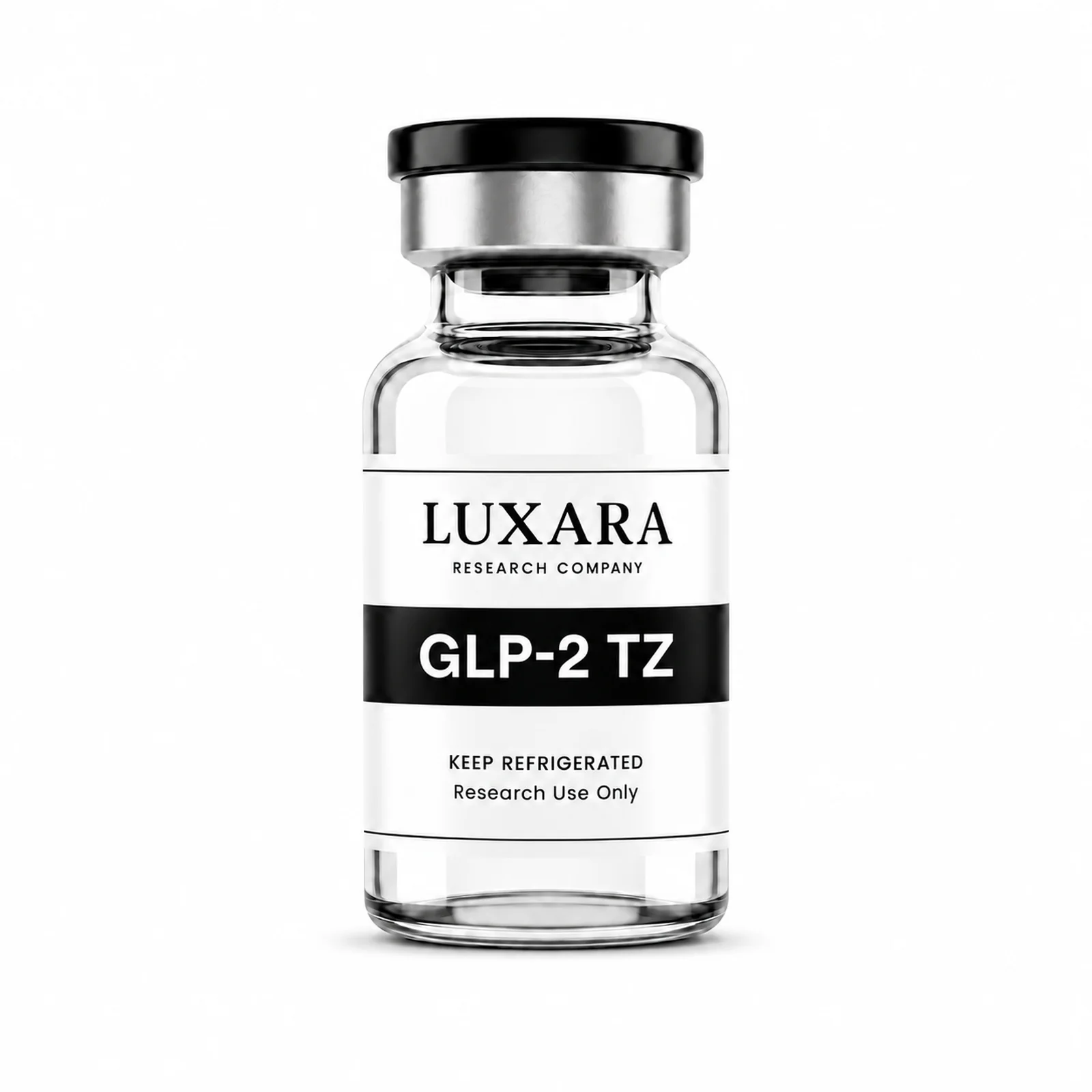
GLP-2TZ is Luxara’s catalogue name for material identified as LY3298176, a peptide characterised by agonist activity at the GIP and GLP-1 receptors. Explore its molecular design, signalling behaviour and analytical documentation.[1][2]
What is GLP-2TZ?
The underlying research identifier is LY3298176. Published structural work describes a 39-amino-acid peptide with a linker and C20 fatty-diacid modification. Its dual-agonist profile belongs to one modified molecule, rather than a mixture of two peptides.[2]
In plain English: one peptide interacts with two receptor systems. The next research question is how each receptor responds, including which signalling pathways are engaged and how the receptors move within cells.
GLP-2TZ is a Luxara catalogue label, not the name used by the independent papers below. It should not be interpreted as GLP-2 receptor nomenclature. Published findings characterise the investigators’ material; they do not independently verify a supplier’s sample.
Compare the GLP-2TZ product specifications with the applicable sample or lot documentation.
Dual agonism and signalling bias
GIPR and GLP-1R are class B1 G protein-coupled receptors. Research examines ligand recognition, G protein engagement, cyclic AMP production, β-arrestin recruitment and receptor internalisation.[1][2]
| Target | Receptor name | Published pharmacological distinction |
|---|---|---|
| GIPR | Glucose-dependent insulinotropic polypeptide receptor | The foundational study reported a signalling profile resembling the native GIP reference in its assays. |
| GLP-1R | Glucagon-like peptide-1 receptor | The same study found a relative preference for cAMP signalling over β-arrestin recruitment, with reduced internalisation compared with its GLP-1 reference. |
Biased agonism describes a relative preference between measured signalling pathways. It does not mean equal activity at both receptors, greater purity, or a universally stronger response.[1]
Cell-based trafficking research also found that strong maximal cAMP responses can coexist with partial G protein recruitment and reduced internalisation. These endpoints are not interchangeable.[3]
Read assay results in context
A receptor-binding result and a downstream signalling result answer different questions. Comparisons become more meaningful when receptor expression, assay format, reference ligand and measurement timing are matched.[1][3]
| Readout | What it describes | Interpretation limit |
|---|---|---|
| Binding affinity | Ligand interaction with a receptor in the specified binding assay. | Binding alone does not establish the magnitude of a cellular response. |
| Functional potency | The concentration–response relationship for a defined endpoint. | Values depend on the cell system, assay conditions and signal amplification. |
| Maximal response | The largest measured response within that experiment. | Similar maxima can coexist with different recruitment or trafficking behaviour. |
| Internalisation | Changes in receptor location or surface availability. | It is a trafficking measurement, not a substitute for binding or cAMP data. |
Albumin matters. The lipid modification can affect albumin binding and the amount of freely available peptide in an assay. Albumin-containing and albumin-free results should not be treated as directly equivalent.[2]
What the evidence adds through 2026
The updated evidence spans experimentally resolved structures, computational work and specialised cell models. Each contributes a different kind of information.
Receptor structures
Sun and colleagues resolved peptide-bound GIPR and GLP-1R complexes. Their structural and functional analyses connect molecular contacts with receptor-specific pharmacology.[2]
Computational mechanisms
Zou and colleagues used molecular simulations to examine receptor activation and peptide–receptor interactions. Modelled contacts and binding behaviour are theoretical findings, rather than newly measured receptor affinities.[4]
Cell-specific signalling
Ren and colleagues studied induced pluripotent stem-cell-derived sinoatrial cells and three-dimensional organoids. Their cell assays linked localised sarcoplasmic-reticulum cAMP signalling with PKA activity and calcium cycling. These findings concern that specialised in vitro model.[5]
Inspect the deposited structural data
| Receptor complex | PDB record | Reported resolution |
|---|---|---|
| GIPR–Gs | 7RBT | 3.08 Å |
| GLP-1R–Gs | 7RGP | 2.90 Å |
PDB records provide models, experimental details and validation reports.[6] A resolved complex does not show every dynamic state or establish the behaviour of a commercial sample. Cell-model observations and computational predictions also require their own interpretation.
GLP-2TZ, GLP-3RT and semaglutide
Receptor coverage provides a useful first distinction. It does not establish interchangeable materials or rank compounds across unrelated experiments.[1][7][8]
| Material / reference | Principal targets | Research distinction |
|---|---|---|
| GLP-2TZ LY3298176 |
GIPR and GLP-1R | Dual-receptor pharmacology and pathway-dependent signalling. |
| GLP-3RT LY3437943 |
GIPR, GLP-1R and GCGR | A triple-agonist profile that also includes the glucagon receptor. |
| Semaglutide | GLP-1R | A single-receptor reference within this comparison. |
GLP-2TZ and GLP-3RT are Luxara catalogue labels. For the triple-receptor overview, read the GLP-3RT Canada Research Guide.
Evaluate the analytical documentation
Literature findings and supplier testing serve different purposes. A publication characterises its own experimental material. A COA supports the particular measurements reported for a submitted sample.
| Attribute | What to check | What it does not prove alone |
|---|---|---|
| Identity | Sample identifier, analytical method and findings supporting the stated molecular identity. | Identity cannot be inferred from a purity percentage alone. |
| Chromatographic purity | Reported peaks, method and the basis of the percentage. | Net peptide content or the absence of every possible impurity. |
| Peptide content | A quantitative result and its measurement basis. | Receptor activity or guaranteed experimental reproducibility. |
| Microbiological testing | The specific assay performed. Sterility and endotoxin are distinct measurements. | Either status from an HPLC/MS result alone. |
ICH Q2(R2) provides general analytical-validation principles; ICH Q6A distinguishes testing categories. These references help explain the measurements, rather than certify a catalogue item.[9][10]
- Match the record: check the product identity, sample or lot reference, report date and tests performed.
- Respect the scope: a shared lot reference does not mean every vial was individually tested.
- Separate the claims: analytical purity is not a measurement of receptor activity.
Review the available reports on our Lab Results and COA page, then use How to Read a COA and the Luxara Quality Standard for supporting context.
Research sourcing in Canada
Luxara fulfils research orders from Ontario, with catalogue prices shown in Canadian dollars. Review the product information and applicable documentation alongside the current Canada shipping information. Researchers ordering to the United States can consult our USA shipping guide.
For a broader supplier checklist, read Where to Buy Peptides in Canada. It explains how to compare analytical documentation, lot traceability and Canadian fulfilment.
Explore the research catalogue
Review GLP-2TZ and its documentation
Browse the current catalogue and compare the listed material with the relevant analytical record.
Frequently asked questions
Does dual agonism mean two peptides are mixed together?
No. The LY3298176 research identity describes one modified peptide with activity at GIPR and GLP-1R. GLP-2TZ is Luxara’s catalogue label for that identity.[2]
What does biased agonism mean here?
It describes a relative preference among signalling pathways in a defined experimental system. A cAMP response, β-arrestin recruitment and receptor internalisation should be evaluated as separate endpoints.[3]
Why can albumin change an assay result?
Albumin can bind the lipid-modified peptide, affecting the freely available fraction. Comparisons should account for the protein conditions used in each experiment.[2]
How does GLP-2TZ differ from GLP-3RT?
What recent research is included?
Does a COA establish biological activity?
A COA supports the measurements it reports. Purity, identity and content results do not themselves establish functional receptor activity. Review the applicable analytical report and its test coverage.
Browse the complete Luxara Research Index or read our research standards and methodology.
Research use only. This guide covers scientific literature, receptor biology and analytical documentation. Luxara materials are supplied strictly for laboratory research and in vitro studies.
Sources and original research
Source labels are abbreviated. Original publication records and identifiers are preserved.
- Willard FS, et al. JCI Insight. 2020;5(17):e140532. Original receptor pharmacology and signalling research for LY3298176.DOI: 10.1172/jci.insight.140532
- Sun B, et al. PNAS. 2022;119(13):e2116506119. Structural and functional determinants of dual-receptor agonism.DOI: 10.1073/pnas.2116506119 · PMID: 35333651
- Novikoff A, et al. Molecular Metabolism. 2021;49:101181. Cell-based receptor signalling, trafficking and recycling research.DOI: 10.1016/j.molmet.2021.101181 · PMID: 33556643
- Zou X, et al. International Journal of Biological Macromolecules. 2025;321(Pt 1):146141. Computational receptor activation and peptide–receptor interaction research.DOI: 10.1016/j.ijbiomac.2025.146141 · PMID: 40692063
- Ren L, et al. Circulation. 2026;153(25):2110–2113. In vitro cAMP and calcium-dynamics research in iPSC-derived sinoatrial models.DOI: 10.1161/CIRCULATIONAHA.125.076669 · PMID: 42330097
- RCSB Protein Data Bank: 7RBT (GIPR) and 7RGP (GLP-1R). Deposited cryo-EM models, experimental details and validation information.
- Coskun T, et al. Cell Metabolism. 2022;34:1234–1247.e9. Original LY3437943 triple-receptor pharmacology.DOI: 10.1016/j.cmet.2022.07.013 · PMID: 35985340
- Lau J, et al. Journal of Medicinal Chemistry. 2015;58(18):7370–7380. Original semaglutide molecular-design research.DOI: 10.1021/acs.jmedchem.5b00726 · PMID: 26308095
- ICH Q2(R2): Validation of Analytical Procedures. March 2024. General principles for analytical procedure validation.
- ICH Q6A: Specifications. December 2000. Technical distinctions among analytical and microbiological testing categories.