
GLP-3RT Research Hub
Find the receptor studies, deposited molecular structures and lot documentation for GLP-3RT, Luxara’s catalogue name for material identified as LY3437943.
Key Takeaways
- Three principal receptor targets. Published assays characterise LY3437943 as an agonist at GLP-1R, GIPR and the glucagon receptor, GCGR.[1]
- Three deposited structures. Protein Data Bank entries 8YW3, 8YW4 and 8YW5 give researchers access to the original receptor-complex models.[2][7]
- Match the lot to its COA. Review identity, purity and measured content as individual results.
Choose a research starting point
-
GLP-3RT Canada Research Guide
Start here for the full compound profile, including identity, receptor biology and the evidence behind triple agonism.
-
GLP-3RT vs GLP-2TZ
Compare dual and triple receptor targeting, molecular architecture, signalling evidence and structural records on matched criteria.
-
GLP-1, GIP and triple-agonist research family
Place the receptor profile in the wider family of single and multiple receptor agonists.
-
Peptide pathway research overview
Find related pathway resources when the research question starts with a receptor or signalling system.
What the laboratory evidence shows
Evidence reviewed through . See Luxara’s research standards and methodology for our approach to selecting and interpreting sources.
Receptor pharmacology
Coskun and colleagues characterised LY3437943 at the glucagon-like peptide-1 receptor, glucose-dependent insulinotropic polypeptide receptor and glucagon receptor. Their reported in vitro profile showed a relative preference for GIPR activity. Use the receptor-specific results and reference ligands when interpreting the profile.[1]
Signalling readouts and peptide design
Dinsmore and colleagues included LY3437943 in Figure 5 comparisons of GLP-1R cyclic AMP signalling and β-arrestin-2 recruitment. The tables, supplementary data and cited experiments establish where each normalised value came from. Wang and colleagues examined separate engineered triple agonists with varied receptor activity and reported preliminary evidence of signalling bias for a candidate peptide. Use the stated molecular identity and readout when comparing results across these papers.[3][4]
2026 molecular simulations
Vishnoi and colleagues included the LY3437943 peptide backbone as a reference in multi-receptor modelling. They modelled the reference without its lipid conjugate. The calculated interaction energies describe the simulated system and provide hypotheses for experimental verification. The authors’ supporting simulation dataset accompanies the paper.[5]
2026 cell-model observations
Figure 8 of Ding and colleagues’ study includes LY3437943 in comparative HK-2 tubular epithelial cell experiments. In the senescence model, the investigators reported a smaller proportion of G2/M-arrested cells and lower collagen III and α-SMA protein expression relative to the senescence control. The results describe those cultures and measured endpoints. Assigning a response specifically to GCGR would require receptor-specific evidence.[6]
Inspect the deposited receptor structures
Li and colleagues resolved LY3437943 bound to each of the three receptors in G protein complexes. The models show a helical peptide engaging the receptor core and distinct contacts near the extracellular surface. The deposited coordinates, experimental details and validation reports help researchers inspect those interactions in context.[2][7]
| Receptor | PDB record | Resolution |
|---|---|---|
| GLP-1R | 8YW3 | 2.68 Å |
| GIPR | 8YW4 | 3.26 Å |
| GCGR | 8YW5 | 2.84 Å |
Resolution describes the structural reconstruction. Use functional assays for questions about receptor response.
Match the COA to the research material
Start with the lot on the material’s label and find the applicable entry in the public laboratory-results directory. Open the original certificate of analysis, or COA, and check the sample identifier, report date, methods and results. Original reports retain the terminology used by the issuing laboratory.
- Identity. Check which analysis supports the stated compound identity. A mass result supports the aspects of identity that the method can resolve.
- Purity. Review the chromatogram and the calculation behind any percentage. A peak-area percentage describes that chromatographic measurement.
- Measured content. Look for a separate quantitative result for the target material and check its units against the label.
- Additional tests. Where sterility, endotoxin or stability data matter to the research, look for the specific reported analysis.
Luxara’s catalogue states a 99%+ purity standard. The applicable report documents the submitted sample and the tests actually performed. Identification, purity and quantitative assay are distinct analytical questions.[8]
Use the COA reading guide and peptide purity guide to interpret the results. The Luxara Quality Standard and transparency resources explain how the company presents testing and lot documentation. See the storage and stability overview for material integrity context.
Research sourcing in Canada
Use Luxara’s Canadian peptide sourcing guide to assess supplier documentation, lot traceability and fulfilment. Luxara lists Ontario-based fulfilment. See the current Canada shipping guide or USA shipping guide for delivery information.
For a report-matching question, contact Luxara with the catalogue entry and lot reference.
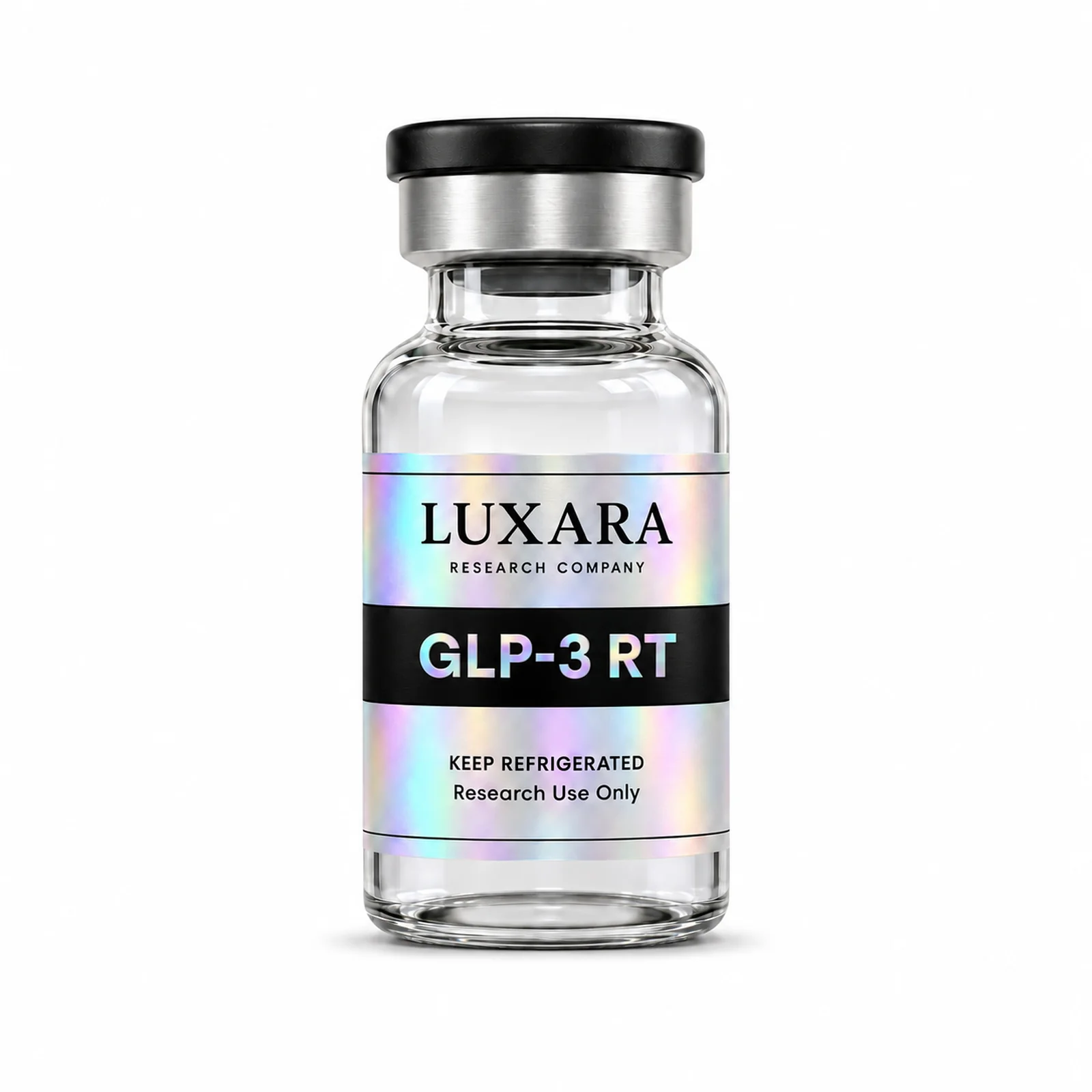
Review the current catalogue entry, specifications and available documentation.
Explore the wider research library
-
Canada peptide Knowledge Hub
Explore broader peptide biology, analytical testing and Canadian sourcing topics.
-
Luxara Research Index
Find the full directory of compound guides, comparisons and documentation resources.
Frequently asked questions
Where should I start with GLP-3RT research?
Read the GLP-3RT Canada Research Guide for the full compound profile. Use this hub to select primary papers, structural data and lot documentation. The comparison guide covers dual and triple receptor targeting side by side.
Which identifier should I use to find the original literature?
Use LY3437943 to cross-reference the underlying identity in publications. GLP-3RT is Luxara’s catalogue label. Papers and deposited records identify the materials used by their investigators.[1][2]
Where can I inspect the receptor complexes?
The structure table links directly to PDB 8YW3 for GLP-1R, 8YW4 for GIPR and 8YW5 for GCGR. Open the corresponding entry to inspect the deposited coordinates and validation information.[7]
How should I interpret a calculated receptor interaction?
Check which peptide form, receptor model and computational method the study used. Simulations provide predicted interactions for that system. Experimental binding and functional assays address measured affinity and response.[5]
How do I find the applicable GLP-3RT COA?
Start with the lot reference on the material and look for the matching report in the COA directory. Check the sample description and methods. Contact Luxara for help confirming a lot or locating its documentation.
What does a purity result establish?
It describes purity for the tested sample under the reported analytical method. Review the result’s units and calculation, and look for separate measurements of identity and content where those are required.[8]
Sources and original research records
- Coskun et al. · Cell Metabolism · 2022;34:1234–1247.e9 DOI 10.1016/j.cmet.2022.07.013. Foundational LY3437943 receptor pharmacology.
- Li et al. · Cell Discovery · 2024;10:77 DOI 10.1038/s41421-024-00700-0. Cryo-EM structures at all three principal receptors.
- Dinsmore et al. · Journal of the American Chemical Society · 2025;147:20819–20832 DOI 10.1021/jacs.5c04095. Multi-receptor peptide design and comparative signalling figures.
- Wang et al. · Journal of Medicinal Chemistry · 2025;68:20765–20788 DOI 10.1021/acs.jmedchem.5c02032. Receptor activity and signalling profiles of engineered triple agonists.
- Vishnoi et al. · Journal of Computer-Aided Molecular Design · 2026;40:191 DOI 10.1007/s10822-026-00903-5. Molecular simulations and supporting Zenodo data record, DOI 10.5281/zenodo.21384682.
- Ding et al. · iScience · 2026;29:117174 DOI 10.1016/j.isci.2026.117174. The findings discussed in this hub refer to the paper’s HK-2 cell experiments.
- RCSB Protein Data Bank · Original records 8YW3, 8YW4 and 8YW5. Deposited receptor complexes and associated validation information.
- ICH Q6A · Specifications · FDA guidance record General analytical context for identification, purity and quantitative assay.